Feedback on Tutor comments for Assignment 4

Overall Comments

Pleased narrative and meaning is coming through in my work as this is something I’ve been working on.

Work sometimes tame but okay because lots of learning gong on… my whole world view of painting has been destroyed (in the nicest possible way). I’m starting to build up a new world view from the ashes and would dearly like to be more adventurous, but my old voice keeps coming out. I guess habits and actions take longer to change than intellectual understanding.

But it is coming, I think that’s what Level 2 will be all about.

Assessment potential

I really want to pass, as an isolated Level 1 student I have no idea how I match up to academic and university level academic and craft expectations, which is another frustration of not being on a full time course and seeing other students work (and ideas), and those of Level 2 and Level 3 students. So it’s useful to know that I have the potential to pass.

Feedback on Assignment:

Ex 4.1

Be careful with representational work because technical aspects of shape and form  need work. When you hone in it’s more engaging especially as it becomes semi abstract. Thin down paint works well for this. 

I have no desire to do representational work but believe that all painting is underpinned by good drawing skills, like Picasso or Peter Doig, so am working on my drawing skills by banning copying photographs, collecting information from sketches. And by attending weekly life drawing sessions.

It’s a work in progress and I am getting better. I think 18 months to two years should see me somewhere near where I want to be.

Ex 4.2

This series more impact – back of the shoes is the best as it gives it a narrative – worked well with detail – good detail and cropping. Hone in has more impact. 

All good – what I’m beginning to learn in just how much process (to such an extent some painting is more like building a flat object through a series of procedures, and that the procedures can become as important as the human input) is involved in painting and that the choice of medium and surface is crucial to outcome.

For these sketches I used pencil crayon which is a very easy medium to control for fine detail. Also, from a purely physical point of view, it’s easier to get in awkward positions and sketch something than it is to do the same thing with watered down paint where you need your paints set up around you.

I agree about the cropping and detail.

Shoes instantly tell a story… I always think of the wonderful old boot painted by Van Gogh.

Ex 4.3

Interesting comments – vibrancy/sculptural aspects of varnish splashed and painted on help visually describe subject in meaningful way. Push sculptural use painting with more texture as gives more dynamic play with paint.

Be careful background is on a different plane.

I loved doing this and really surprised myself. It’s ones of those exercises I did because I had to, didn’t think I was going to learn anything, and ended up having a great time and learning loads.

It’s really a case of bravery… of playing… and limited financial resources… if I’ve put effort into a painting and then throw sand at it or spatter it with varnish it’s a risk. I might waste my time and money. Or, it might make a brilliant painting. It’s definitely something I’ve got to overcome as I loved the results and it made for a much stronger painting.

Maybe it’s a case of planning it into the ‘process’ of making a painting. And I still have to kill the idea that a painting is paint smeared on a canvas with a brush… it can be anything glued, stuck, spayed, smeared, painted or even burnt in or onto any flat surface – more what I would have thought of as a sculpture in the past.

But a seed has been planted.

This was a fantastic exercise and has really moved me on.

My only caveat was I saw a painting recently by minor (fully qualified) local artist who’d use a whole range of different processes on a canvas and it totally fractured the result, it looked like ten different paintings. A dog’s dinner of a painting.

I’m not quite sure what Diana means by the last comment or how to achieve it – I’ll just have to remember to ask on my final feedback.

Ex 4.4

Shoes most effective as have identified with narrative.  Would be good to push impasto to increase movement and grittiness… compositionally could have included old walking boots. Play with textured surfaces can be pushed more.

I absolutely agree and was cross with myself. I painted into the thinned down paint but only to opaque out colours and with minimal impasto or brushwork.

What I wanted, in retrospect I would go back and do again is have some places of heavy impasto and really slap the paint on so the brushwork could add movement to the painting.

In my defence, I was worried about cost as you can easily get through a £5 tube of paint on one small area. However, I’m just going to have to go for it and make it count… I want to paint big but for now (until I start selling some) I’ll have to go small or choose carefully where I impasto.

What I ended up doing was making a thicker version of the thinned down paint when what I’d wanted to do was was produce crusty shoes with personality and brush strokes which filled the canvas with energy and pushed the viewer round the canvas.

Assignment

 The work is clean and clinical which suits the nature of the scene and intended narrative. You have charged yourself with being realistic and representational. It does work in a tondo but where is the intrigue? Is it too obvious? If going for hyper-realism there are technical issues such as cleaner lines and more realistic tones. Overall a good challenge.

My intention was hidden at the bottom of the write up, so have moved it up to the start and added it below, underlined in bold.

“I’ve decided to go for oils, and as I’m not painting this fast and free I’m going to try making it into a slightly abstract by the geometrical structure (where the lines dissect and shapes echo (I did this when I was drawing up). And go for flat areas of colour… I’m not being bound by local colour but composing it as I go along…  I’m also going to try and use subtle tones.

My aim is to create a surreal interior which on the surface looks real but with subtle colour and compositional changes so it pulls the viewer in while pushing their eye to the window. By doing this it will take the viewer through the interior space to the outside, which we can look at and experience but never be part of as we live internally in our heads.”

Diana’s comments are useful if ever I want to go for hyper-realism but but in this case I specifically wasn’t going for hyper realism. And the enhanced tones were a deliberate choice.

My intention wasn’t to be realistic and representational, merely to appear realistic on first glance, but to be unreal. The dynamic, between seeming real and unreality, was meant to push the viewer to realising that their internal space is subjective, and yet it is this very subjectivity which determines what they see ‘objectively’ (and accept unquestioningly) such as a tree or cloud.

My aim was to question the nature of reality and seeing. The intrigue was not the on first glance, ‘reality’, but to mirror back to the viewer how they always see the world through their own mental filter.

Sketchbooks

Sketches/planning supportive for intentions and concepts. Some exciting drawings going on… could these be translated into painting? More expressive?

Firstly I’m really pleased than I’m understanding and using my sketchbook better.

Secondly, I would love to develop sketches into paintings, the two constraints are time and money. But things change and who knows?

Making an Assignment piece that is less free than the my sketchbook work was a huge problem when I started the course… a bit like Cambridge Utd the first time they got to the play offs at Wembley having been non league for ten years. Having fought like lions all season and beaten their opponents in the league they were like rabbits caught in headlights, froze and lost 4 nil. It was an unmitigated disaster.  It took them two more seasons to be able to go to Wembley and play football.

Compared to my first Assignment of my first course four years ago I’m much freer and looser and I thought I had this sorted.

But just because I’m not aware that I’m approaching the Assignment differently, doesn’t mean that I’m now relaxed and free, just that I’m not obviously in a total panic.

Diana’s comments are really useful as they allow me to go back and think about my sketchbook and Assignment with new eyes and see that although the gap is less, there is still a tightening up on the Assignment. It’s no longer fun and play, it matters…

I’m sure this will come and the ideal is to be as loose and expressive in the Assignment as the sketchbook work – I’m working on it.

Research

In depth and imaginative – you are learning and questioning to develop your personal voice – insightful while keeping your own practice in mind in relation to narrative of others.

Good to hear as I’ve been working hard on this… and trying to find where my artistic voice fits within painterly concerns and within the art market.

Learning logs or Blogs/Critical essays

Essay plan

Good plan look at two artists and relate through ‘meaning’. Good to see where your voice comes as an artist. Be careful not to include too much or will be breadth and no depth. Social, cultural and political context may be too much.

Great advice, which I’d also been given by an academic friend. It’s helped me focus down on one very specific aspect and examine it, almost, out of time. How historic conventions (social/cultural/political) determine artistic output is a whole essay in itself, and not what this essay is asking for – which is to compare two artists use of the same medium and relate it to my practice.


Suggested reading/viewing

  1. Patrick Caulfield – relating to assignment.

(1936 – 2005) Wikipedia entry: English painter and printmaker known for his bold canvases, which often incorporated elements of photorealism within a pared-down scene. Examples of his work are Pottery and Still Life Ingredients.

After Lunch 1975 Patrick Caulfield 1936-2005 Purchased 1976 http://www.tate.org.uk/art/work/T02033

After Lunch 1975 by Patrick Caulfield 1936-2005
After Lunch 1975 Patrick Caulfield 1936-2005 Purchased 1976 http://www.tate.org.uk/art/work/T02033

Interesting artist but conceptually very different to my assignment – and in painterly terms he always thought of himself as a formalist (to do with the flat painting surface and colours/composition etc).

I was trying to make a surreal reality (and wasn’t aiming for photorealism/if anything the opposite) with heightened colours and a semi-abstract geometric composition to express a concept about the nature of perception, while Cauldfield is playing with hyper reality/printmaking and design to set up a dynamic tension about modern living.

2. Michael Craig-Martin – playing with clean colours.

(b. 1941)

Knowing, 1996

T07234_10.jpg

I heightened and flattened colours (and moved slightly away from local colour) to disorientate my viewer and make them think about the nature of seeing.

In ‘Knowing’, which is positioned by the title Craig-Martic asks the question… How can we know? What do we know? How do we see everyday objects?

By focussing solely on solid colours he stops us using our normal process to construct the image and as we slow down and build up our seeing we become aware of the process and realise that seeing is a construct, and how little we normally ‘see’ of everyday objects.

So, it’s a bit like a film that takes one small element and blows it up to monumental proportions.

What I particularly like about this use of colour is the laser like focus and understanding of what the colour is doing.

For my practice it makes me think that I I maybe shouldn’t always try to be so subtle (the message gets lost) but think about how I use colour, what I want to achieve and then go for it.

Be radical.

3. An interesting article on Elizabeth Peyton – http.www.the guardian.com/artanddesign/2009/apr/08/artist-elizabeth-peyton

Fascinating article which will give me material for my essay… and can go in the bibliography, if I can figure out how to Harvard reference it.

She starts with glossy press photographs and turns them into 11 inch painted portraits – making something distant and unattainable into a personal friend, like a fan might imagine they know the star. On one level she’s making her own ‘fan painting’.

The way she chooses her subjects reinforces this as she only picks stars whom she respects, for being true to themselves with their rebellious behaviour, and not becoming marketing puppets. Given this personalisation of fame it’s not surprising her paintings drip romance and mysticism, like her weeping paint, and transform a slick publicity image into personal treasure.

The irony is that these treasures can now sell up for up to half a million pounds and are as unattainable as the stars themselves.

Interestingly she has always drawn people and her first exhibition was not of pop stars but royalty.

For my practice this has five take aways:

  1. She has a personal investment/connection with her subject which fills the canvas. This is honest and the public react to it.

So, always paint something I’m connected to.

2. Size isn’t everything, it depends what you’re painting.

I don’t have to go big to be successful… size like my choice of medium and surface depends on what and why I’m painting it.

3. If you have a unique brand based on sincerity and skill that cuts through to an audience you can be very successful.

This is totally different from trying to guess the market and paint images that you don’t care about just to sell them.

Or equally, to hit on a gimmick or process like Gary Hume – he takes a photograph, traces it onto acetate, projects it onto aluminium, and then paints it. Yes he has a market and his objects look really cool and are desirable – but I don’t see the difference (apart from scale and skill) between what he does and making little glass animals for Blackpool pleasure beach.

So paint something I’m really connected to.

4. I have told myself this many times… but painting isn’t about copying or making a realistic representation of something in the real world.

My take is be brave and experiment – that’s what doing a degree is all about.

5. Finally, although I am interested in ideas this makes me realise that what I really want to paint is visual language and things that matter to me, I don’t want to paint visual versions of ideas. I’m not a concept artist.

My painting is much more akin to my acting than my hermeneutics degree.

This is, after all a painting course… and I want to paint.

(PS: I do feel that there is an undue weight on the course towards concept art and Fine Art, rather than painting. But maybe that’s just because the UCA doesn’t teach a pure painting degree.)

Pointers for next assignment:

Strengths:

  1. Play with semi-abstraction plus honing in – this could be pushed.

Noted… I’d like to push the semi abstraction and but have mixed feelings about the honing in.

As a technique honing in is brilliant but does cover for a lack of skill – Hopper didn’t hone in (he honed out) which was part of his style and integral to his meaning.

So, so long as I’m using it as a deliberate artistic choice, or with an awareness that it’s covering for a drawing or compositional weakness, then I’m fine with it.

2) Variety of painting styles and good to see you understand what different finishes and media can do.

I agree, though to say I’m barely scratching the surface is an understatement. But every journey begins with the first step – and in my case that might be the hardest. As I loosen up and feel easier and braver I should be able to play with painting styles and pick the most appropriate for whatever I’m painting.

3) Learning log and self reflections apt and insightful.

Yes, this is a huge part of my learning. I spend as much time looking and reflecting as painting. Which is probably out of balance. But I’m filling in for not having a painting background or done foundation art.

For me, although the craft is essential, it’s only another tool like your paint brush. What really matters is what’s inside your head… your understanding of visual language… connection to other artists… how I see the world.

And that’s what the learning log is slowly building up.

Areas for development:

  1. If want to go for hyper-realistic work technical aspects need working.

Luckily, I don’t. (But I still want to improve my drawing/technical aspects as they are basic skills that underpin all painting)

There would have been a time when I would have been upset by this, when I saw painting as fundamentally a skill based profession where success was judged by how well you could mirror nature/a photograph; but hyper realism is a very, very, minute, tiny sliver of painting today.

It can be a choice, and then you need to put the craft elements in place.

Also, many craft/applied arts – hand chair making and marquetry for example have a higher technical level than artists/painters – for example Angelo de la Cruz, Broken into Pieces, 1999 (a broken painting thrown in the corner) or Monique Prieto, Walked, 2006 (crudely painted text on a multi coloured blotchy canvas).  So skill, of itself, like hyper-realism in painting, is no longer one of the main definitions of being an artist.

The skill range of artists ranges from virtually nil (many concept artists) too highly skilled (Picasso).

Traditional oil painting degrees as still taught in Poland and enable graduates to produce traditional 18th and 19th century paintings, but nowadays that is more seen as producing craftspeople to serve a market than producing artists.

2) Think about compositions – not too much empty space but rather a honing in.

I agree.

Hopper’s empty space was full of meaning… so was not empty.

Dead space is a killer. And until I develop my skills sufficiently to be able to fill ’empty’ space by filling it with meaning (like a carry over line at the end of a line of poetry), I need to find ways round it. And close/photographic cropping is one way that works very well.

3) Keep working on your essay but don’t include too much. It would be good to have a hook and question, which you are referring to throughout. E.g. narrative.

Is a hook and question the same thing – I need to ask my academic friend as I’m not clear about that.

I understand about not including too much and have already discarded about half of what I was going to write about.


Essay Plan: Historic and Contemporary use of a painting medium.

I’ve decided to pick oil paint and look at Constable’s oil sketches as compared to Elizabeth Peyton’s finished paintings.

My argument is that oil paint is a medium that can be used for magic (to paint trompe l’oeil, a  window on the world… an aesthetic ‘photograph’) or as a way of capturing the essence of being human.

Because of when he was working Constable had to produce a market product, a beautiful realistic landscape, which oil paint as a medium is very good at. But he was a genius painter so also captured, in his oil sketches, the essence of what it is to be human and look at those views. So although he was involved in a skill based profession he rose above it and included an essence of something else (of humanity) which he took from his oil sketches. Today, his oil sketches, or a development of them, might be more popular than his ‘realist’ paintings.

He had to use his sketches to make his ‘finished’ paintings but because of photography and the revolution in painting painters are now free to express their humanity in whatever way they want. They don’t have to paint aesthetically finished realistic paintings. Elizabeth Peyton can capture the need of a fan to see a star as human, and cut though all the mythologising. In the past she might have been asked to create the myth in a ‘traditional’ portrait.

This in essence is exactly what Constable did with his oil sketches, he saw nature with love and passion, and captured it in a few masterful strokes.

So my conclusion would be that the contemporary and historic use of oil paint in thin and loose oil sketches is the same but that it’s value changes because of cultural, historic and artistic changes.

I’d also put in some personal, social, cultural and political context and relate it to my practice.

And finish up with how the influence of both artists in capturing ‘meaning’ in a non verbal/visual language feeds into my developing voice; particularly the suggestive and gestural qualities of loose work as a way of capturing immediacy, the painting process and a personal artistic response to the world.


Review of Part 4

Demonstration of visual skills:

I have used a range of media including pencil, pencil crayon, acrylic and oil paint and gloss varnish, both in combination and individually to create a range of successful images. This has involved a range of techniques, especially with my first ‘proper’ oil painting, and compositional skills.

I’m especially p[leased at how my observational skills have improved since I banned photographs and started going to life drawing every week. I got back to the level I was at the end of Drawing 1 and started to move forward again. This is both very exciting and satisfying.

Quality of outcome:

Not all my exercises work but I am very happy with my Assignment which I think captures both my conceptual and visual ideas.

The work I put into creating geometric abstraction within the work creates interest and adds energy without destroying the seeming realism.

And the concept of travelling through our own internal space, we can only see out through our eyes and know the world through our senses, is conveyed by the viewer having to travel through the interior space to look out of the window.

This was achieved by by applying all my knowledge from reading the Essential reading on the course and applying it to how artists achieve internal coherence in their work.

Demonstration of creativity:

I experimented with my Assignment by drawing a series of sketches before choosing the best one to develop, something I would never have done before and that I discussed with my tutor.

Having selected the best sketch I then developed it with my imagination, I only used the sketch as a rough guide and changed lots of elements to give my painting its own internal language.

My personal voice is developing.

I know that I want to paint meaningful paintings where I can abandon myself to the process. Ultimately I’m drawn to semi abstract dream like loose style which is a mixture of Peter Doig and Elizabeth Peyton.

So far, I haven’t painted in the physical ‘style’ that I think will be my voice but discovering oil paint has been a huge step forward. And even though this Assignment wasn’t thin, loose or gestural it was mentally free and that’s a step forward.

Context, reflection and research:

I looked at all the OCA suggested tondo artists in depth though the examples didn’t feel very well thought out. The artists only used a tondo on special occasions (many weren’t available online) and all of the paintings could have been equally successful if re-framed in a rectangle. But, it got me thinking about the shape and why artists might use it.

Reflection is a big part of my learning process and I apply all my reading the the ideas I pick up to my painting. I’m starting to go to more real exhibitions (of every level) much more – though cost is a restriction as they always involve travel and usually an entrance fee.

Review your work for Part 4

Qualities of the medium I’ve chosen and how do I hope to exploit these?

Oil paint has a lovely buttery texture and dries to a gorgeous sheen. It has a natural physicality whereas acrylic always has an acidic chemically edge. The colours don’t change as they’re drying and you can work on un-thinned paint for a week or more.

You can varnish oil but the finished paintings look complete and don’t have that slightly arid, sharp edged quality of acrylic canvases.

The most appealing visual quality is the naturalness of the colours, even bright colours have a mellow edge. If it was an instrument oil would always have a gentle burr rather than a brittle screech.

I intend to exploit this by painting atmosphere like Richard Diebenkorn and emotions like Van Gough… I want to paint what I see and feel, and oil paints feel like I could wear them like an old jacket. So, it’s an emotional choice.

Financially acrylic is much cheaper so I’ll still probably use that for larger paintings.

Demonstration of visual skills:

I feel my visual skills are improving as I continue to ban photographs and go to weekly life drawing classes. As I paint from sketches I am learning what information I need to record, and my skill at capturing a 3D shape in space is developing.

In this exercise, even though my primary aim isn’t to ‘paint a photograph’ of reality my improved drawing and visual skills are helping me use my subject as a vehicle for what I really want to say.

Quality of outcome?

I think my viewer can connect with what I’m trying to say, though that’s obviously a difficult call without asking people.

And some of what I’m communicating isn’t meant to be on the surface such as my clothes basket. I want the viewer to be pleased and held by the image without entirely being aware of why. I don’t want them to think and rationalise/reflect on the painting in the same way I am… they shouldn’t be theorising about the nature of our house as an extension of our body, the walls as a second skin… how we decorate our living space like we tattoo our bodies, or want to pick up the clothes basket and take it upstairs.

I want them to be aesthetically pleased by the patterns and drawn in in a way they’re unaware of.

In short I want them to be held by the painting and enter into the picture space physically and spiritually, not look at it and think about it in words.

Demonstration of creativity:

Because I am working from drawings (and learning to draw rather than copy photographs) I have a much richer source of raw materials to draw from. As I own the experience what I can make from it, how creative I can be, expands exponentially.

Everything I read from my Essential reading list changes and feeds back into my understanding of what I’m painting. This can be worked out in my log book, in sketches, in words in my learning log or creatively by letting the work suggest new directions to me as I’m painting it.

Equally, in an ironic sense, it can come when I review my work and realise why it hasn’t worked, which isn’t usually down to a lack of skill (although that’s obviously a factor) but because of a lack of creativity. If I’ve failed to connect to the subject in a creative way the painting is boring and doesn’t work.

If my painting is full of meaning for me it’s creative and interests the viewer. So, to an extent, the work itself is also a demonstration of creativity.

Context:

I research all the artists mentioned in the critical brief and reflect in depth on my own work and the artists who influence me.

At the moment I’m reading a few pages of Painting Today by Tony Godfrey every day which is a huge revelation. Everything he talks about, and all the artists he mentions, change everything I’ve read and understood so far about painting, both in my own work and placing artists in their wider historical and social context.

I may not mention them all as it’s like a huge cavern with a big river pouring in artists, history, convention, personality… all swirling round and bubbling away. So for my paintings and the paintings I’m viewing I’m constantly thinking about different contexts.

A final note on this is that having spent years avidly reading populist art books cover to cover, and being swamped in illustrations in text books, I’ve been seized by a great desire to see real paintings… the good, the bad, the stars and the ugly.


Exercise 4.4 Use the paintings from 4.1 and add thicker paint. Leave some areas thinly painted. What effects have you created by applying the thicker paint?

The thin fluid acrylic paintings are on the left and the same paintings with thicker oil paint added are on the right. These were all painted on a flat table.

  1. 60 cm diameter brown corrugated card painted standing up using a palette knife.


It shouldn’t be my first reaction but what struck me was the cost, I probably used at least a tube of oil paint which is about £6. Not huge if you’re selling a painting but it would soon add up on exercises and on a large canvas would be a significant cost.

This raises the issue of being in control of the means of production and access to different styles of painting such s painting large canvases or using heavy impasto.

One way round the cost of impasto would be to work on small canvases and scale up as you become more skilful and started to sell your paintings, or to use small areas of impasto on conventional paintings.

What I’m quickly learning is that painting with a brush, smearing oil paint onto a flat surface to produce a thin film of paint resembling a ‘photograph’ (a realistic 3D image on a 2D surface) is only a very small part of what painting is about today. And that you can use anything to apply your ‘paint’ to any surface – the restrictions being the durability of the finished product (arte povera is not yet proven to stand the ravishes of time and has built in obsolescence, like modern cars they fall to pieces after a given number of years, unlike traditional oil paintings which last for centuries) and and whether anybody will buy something that is going to fall to pieces. Which raises the issue of painting as investment? Painting as a political/social comment? Painting for a market? To what extent is a painting ephemeral (like performance art) or a permanent object (a commodity) to be bought and sold?  And how does the artists pays his bills?


Back to this painting… I love the effects created by impasto paint laid on with a palette knife.

A few carefully placed dabs of white and black are enough to flag taps… you don’t need the detail. And I think these taps are stronger than if I’d painted them ‘realistically’.

I also love the texture created between the taps and underneath the cloth. This could be part of a bigger painting and is visually arresting. Aesthetically the lines, indents in the card, and tonal shifts are very engaging and couldn’t have been created in any other way.

Equally the slabs of colour on the flat work surface have a different quality than if they’d been brushed on.

On the cloth and tiles I’ve used impasto with a knife as if it was a brush a brush and it doesn’t work. Impasto has its own technique and visual language in the same way that a tune played on a mandolin is very different to one played on an amped up electric guitar.

2) 23 cm diameter drawing paper – painted using small brushes sitting at a table.


The thinner paint on the carpet drew attention away from basket of clothes and highlighted the painting surface. The thick paint makes it into a solid patterned carpet: both solid in a Mondrian sense of graphic abstract and also as a carpet, which is flat like the painting surface.

Adding white to the wood lightened the painting, added grain for more realism and made the floor into a solid surface; while the reflections indicated a well lit room and cared for wooden floor. So made it into a middle class household with all the meanings that brings.

I decided to show the carpet through the holes in the basket to maintain an element of realism and put the basket on top of the carpet, and the heavy paint let me do this.

I left the clothes thin, just adding a tiny bit of detail, as I wanted to paint them differently from the carpet and the floor.

My idea was to counterpoise the random pattern of the clothes against the structured pattern of the carpet as a way to capture my different feelings for the clothes and the floor, something we’re not usually aware of. The basket is going to be picked up and the clothes ironed, folded and worn, so we have different connection to this than the floor. The floor is a fixed and part of the ‘skin’ of the room, whereas the clothes are passing through, we wear the clothes… we don’t wear the carpet.

3) 53 cm diameter white mount board  painted sitting down and standing up using a variety of brushes.


I decided to enhance the colours on this and go cartoony.

The overall painting is not entirely successful as there are two contrasting styles.

The slabby almost impasto oil paint (though applied with a brush rather than a knife) works for the tiles, candles and essential oils. My idea was to use the heavy paint to see how little I could add and still signify real objects… and even though the shapes are off and there’s no subtle tones or modelling it works well. The surface zings and we have two opposing gangs, the candles and the oils. It begins to set up a cartoony dialogue.

However the rest of the painting is dead. I tried to make the brickwork and wall ‘real’ but it just looks flat and lifeless.

It’s partly the composition but the heavy paint on the bricks looks like paint on a canvas, not a brick nor a pattern. So I needed to paint this in a different style and not ape realistic painting.

In this painting I needed to harmonise my technique for the heavy paint.

4) 34 cm corrugated packing card painted sitting down using medium and small brushes.


These two paintings are not hugely different as I’ve used the heavy paint in the same way as the loose paint, using the loose paint as an underpainting.  The heavy paint corrects local colour and make sense of the light holder.

I did have in mind some of the Futurist painters with my lines of power coming out of the light, but it looks more like a chrysanthemum.

To be honest I couldn’t find a link to this painting so it became about describing physical space, which I find boring. Like painting the vehicle (the outer subject of any painting) without a driver. A car is only useful if it’s taking you somewhere and this subject is parked in the driveway.

The main thing I got out of this (as I’m still on my ‘No photographs’ allowed) is just how much information/and what information you need to capture in your sketches to enable you to paint reality… how much can you add by suggestion… and what you can work out through your knowledge of light source and 3D shapes in space.

5) 34 cm white mounting board painted sitting down with small brushes.


This is one of my favourite paintings because it looks real but was painted from a sketch; because it adds a narrative: Who’s shoes are these? What is their owner like? Can I imagine the house around them? And it also works on the level of laying down a pattern of squares, rectangles and curves against the more natural (but still man made) pattern made by the shoes.

I want to pick up the deck shoes and go off on an adventure… on holiday? On a boat? So I have a physical connection with the painting, it gives me the feeling of an adventure about to begin.

I used the heavy paint to model the background wood and just a little bit on the tongues of the shoes. I like the way the outer leather shoes are loose and the central blue shoes are heavily painted, as well as the colour this is what draws me to them… their physical reality.

Here, even though I used the heavy paint to complete a loose underpainting it works because I was connected to the painting and wasn’t really painting the shoes – I was painting everything else and the shoes were just a vehicle.

It also works on a colourist level as I used the heavy paint to add a bit of redness to the wood, so the yellow and orange wood harmonises. The aquamarine blue splits the difference between being a complementary colour to the yellow (blue, blue purple) and to the orange (blue with a drop of red) while its pinch of red ties it into the red brown shoes and reddy wood. So the painting has a peaceful energy – ready for action – which matches its narrative.

Exercise 4.3 Make a very fluid painting from list, when dried gloss varnish. What effects can you make?

34cm diameter circle on hardboard, standing up using watered down acrylic:

imageedit_12_9645462252.png

And my varnished version:

imageedit_6_5910248540

I like the drip effect as it looks like I’m looking at my painting through a rain spattered window or shower… it puts an invisible plane between me and my subject and creates space in front of the canvas. They could also be the the drips from the tap or the cloth captured ‘inside’ the painting. Or they could be drips on a camera lens or glasses.

I can see narrative, non representational and ‘sculptural’ painting where this might be a really effective tool.

Firstly, I brushed on a light even coat of varnish, then squirted on a thicker layer and brushed it into pools between the folds of my cloth and finally when it was dry spattered on drips of varnish – just to to see what would happen.

Generally the varnish deepens the colours and gives the painting depth without making it too shiny, even though this was a high gloss varnish. The thin and thick varnish changes the texture and ‘visual depth/richness’ of the surface and colours which is quite a cool effect as it changes the emotional and physical feel of different areas of the painting.

For a standard painting I think you’d probably go for an even varnish, because in that case you’re not ‘painting’ with varnish but using it as protection and to give the colours depth. However if you incorporate the varnish into the structure of your painting it becomes another tool to alter the emotional and physical structure of your paint.

One way may be to think of it in the same way as you would any other non coloured painting medium such as gel for impasto painting.


Exercise 4.1 Make a series of five circular paintings using thinned down paint.

I picked the best five of my pencil crayon tondo’s from 4.2 and painted them.

1) On a circle cut from A4 drawing paper – oils thinned to viscosity of acrylic paint.

imageedit_1_8535523511

I have decided that as I’m not a human camera copying what hits my eyeballs I don’t have to stick to local colour, and I can play about with design. Also, working from a drawing means that, unless the object is simple and you’re intimate with it you don’t have the detail so you can’t be too tight as you either have to suggest the shapes and shading, or play.

With this I decided to play, so have made the basket black white and grey, with white and black for the holes… in reality you could see through these but I thought it would be interesting to make the washing basket ‘solid’ like a boat so have painted in the side cutouts black and white.

I’m playing with geometric abstraction while still making it read as a washing basket… and also improvising a bit. I quite like some of the patterns of the flat paint describing the clothes inside the washing basket.

The basket is not quite right but is not decorative and sits well in the tondo. The curves of the basket echo the tondo and the straight lines give the eyes a pathway… breaking the edge of the carpet and putting the clothes over onto the floorboards links the two sides of the painting.

2) 60 cm diameter brown corrugated card from a big box a picture frame came in, watered down acrylic (watery consistancy) on a flat surface.

imageedit_5_5063885141.png

`I decided to use acrylic having seen the Frank Bowling exhibition and because of cost. What struck me about the Bowling exhibition was how technical his painting was in that as well as working with chance he had a deep understanding of how all his media reacted/pooled/flowed/ stuck/blended etc.

And it will be a chance to use mixed media as I’m going to paint back into it with oil paint.

I love the pooling of the colours in the pockets of the card and how the paint has run together.

This was pure fun and a vertical learning experience.

There’s a couple of early lessons… one is how important the viscosity of your paint is; for instance the grey under the tap is too thick and hasn’t pooled but the the wood surface behind is too thin and hasn’t enough colour. Another big lesson is that the absorption and texture of your surface is hugely important.

I think my biggest mistake was trying to ‘paint’ the tap – there comes a point at which there’s so much paint around there’s a danger you lose clarity, better to let it dry and paint back in.

But there are some lovely bits of the painting and I’m really pleased. I especially like  parts of the cloth where I’ve begun to capture some of its luminosity.

This is very exciting as visually and texturally so many things are happening at once. But it’s a bit like trying to predict what a bucking bronco will do next and at the moment I can’t control enough of the process. It’s running away with me rather than me riding it. I like the energy and randomness but need more control. However, the concept of working this way is the most important thing… it’s like suddenly discovering you can fly.

I went in my studio this morning and the card had curled round like a banana, which is another point about knowing your materials. I’ve bent and curled it flat but it now has little straight lines in it.

3) 60 cm diameter white mounting card, watered down acrylic (painted standing up with watery acrylics on a flat surface.)

15656451947551345.png

This is fun… I mixed the colours in mugs then diluted them, the surface was quite absorbent so I could overpaint quickly which built up some lovely effects (these are easier to see in life than the photograph), and the white card backlights the thin colour washes giving them a real zing.

I love the way the edges are smudged and blended and the randomness of the shadows. Compared to photo realism it’s quite abstracted, yet it’s clearly a painting of my shelf.

There’s no texture as the surface is smooth, no brush marks and no pooling… so a very different feel and finish just by changing the painting surface. The brushes and diluted acrylic were the same as the previous painting.

What’s really interesting about this is that even in this raw state it’s beginning to do something my tight paintings never did. It has the beginnings of a presence, almost a personality. I can’t explain it but I but can feel.

It’s speaking a different visual language to my tight paintings and is a very different way of working, much freer… looking and feeling rather than copying, more in the moment and with the hand an extension of my brain (thoughts and feelings) rather than separate from it.

4) 34 cm diameter brown corrugated card, smooth side, watered down acrylic (painted standing up with watery acrylics on a flat surface.)

15656451947551345.png

I painted this slightly differently using watery acrylic mixed in a cup, water on my palette to dip my brush into, mixed pools of different ‘runnyness’ on my palette and neat paint onto wet paint.

I did this because with a wash I would have lost the light bulb holders and I wanted some structure. But even neat acrylic is like watery oil paint so I think it still works in terms of using fluid paint. And is a good experimentation in working loosely as I kept the same freedom of application.

Another lesson I’m learning is that different paintings will require different working methods. And the way you ‘make’ your painting is as important as the media and support.

My favourite bit is where the three copper pipes run into the ceiling rose, the random pooling of the brown paint and suggestiveness of the copper pipes works well. The shape of the glass holders is slightly out.

5) 34 cm diameter white mounting board, watered down acrylic (painted standing up with watery acrylics on a flat surface.)

imageedit_9_3797595757.png

I’m quite pleased with this as I think it works as a colour composition, semi abstract, and interior saying something about the space/person.

I especially enjoyed using multiple washes to build up tone and ‘visual texture’.

I had lots of little pots of colour which I watered down and also mixed watery pools on the palette. I used my metre ruler to make sure the lines matched up, and working from colour sketches tried to imagine the original structure, light source and how the light struck the objects.

Although I was working from a sketch I adjusted colour as I went along rather than copy the sketch to produce a Mondrian type framework (Frank Bowling is an inspiration there, and how he incorporates grids into his paintings) for the shoes. It was fun to play with the planes of colour and semi-abstract them as well as making the painting work as an interior.


Exercise 4.2 Make a series of three circular pencil drawings, using coloured pencils.

Circle inside A4 drawing paper, drawing pen and pencil crayon.

I have done this exercise first as I wanted to use these tondo’s as data for my loose paintings.

Firstly, I made a circular viewfinder and squinted through one eye, but I didn’t want my drawings to be 2D so once I’d played around to find the best framing I put the viewfinder away, remembered where the circle was, and composed the drawing inside the circles I’d drawn on my A4 paper.

I decided to draw two views of each so I could experiment with what looked better in the tondo.

As I’m not using a camera (though I am using camera cropping) I had to get in some very awkward positions to draw these, for the ceiling rose I was on my back on the floor. It was possible to sketch and then colour but would have been impossible to paint ‘plein interior’. After I’d sketched them with drawing pen I looked, remembered tone and colour, and gradually coloured in the tondos. It’s great for learning where light falls on a surface and brilliant for training visual memory.

My visual memory is really improving since I stopped using photographs and started going to regular life drawing classes, I really enjoyed this.


Part 4: Research point

1) Research some of the artists mentioned in the introduction.

2) Can you find any other tondo paintings? (Decide why the artist has used that format). Focus on artists who have painted domestic interiors.

3) Does this research give you any ideas for your tondo painting?

………..

List of artists mentioned:

Historic; Michelangelo

Contemporary; Mark Fairnington, Roxy Walsh,Iain Andrews, Henry Acloque, Mindy Lee, Virginia Verran

There are two elements to this research; firstly the tondo and secondly domestic interiors. I find the idea of tondos very interesting because I cannot think of any famous painters or paintings that use this format (I’ve almost completed ‘1001 paintings you must see before you die’ edited by Stephen Farthing – I’m on page 923 – and the paintings are in almost every shape – and merge with sculpture – but I can’t remember any that are tondo).

As the notion of the circle representing the whole seems perfectly logical, whether in a religious or secular connotation, I wonder what it is about this form which makes it so rare in mainstream painting?

Is it just that it’s easier and cheaper to make rectangular or square canvases?

I suspect not, for although for a beginner a canvas is a big portion of your costs for a painting fetching £100,000 to several million it is inconsequential, and if it improved the result it would be used.

Could it be the recognition factor? That the viewer is used to rectangles and can’t ‘read’ circles?

Possibly, but I doubt it as the viewer is very flexible with what it is sees as art both in shape, form and content.

Could it be a hang-back to the origin of paintings as ‘windows’ onto the world?

Given the phenomenal range of art in terms of shape and content the viewer could cope with a circular painting, so it must be something about the nature of painting and the nature of meaning within a circle.

Given Part 4 there is obviously a strong sub-genre of tondo paintings, both historical and current. And given that artists are always looking for new gimmicks and angles, if circles (tondos) worked somebody famous would be using them. My best guess for this anomaly is that there is a fundamental psychological difference between presenting ideas/emotion/vision in a circle and presenting them in a rectangle. Possibly most ideas are not whole, or the rectangle facilitates a different way of reading visual material than a circle?

Would all over paintings work in a circle? I will try in my sketch book.

Tondo artists:

Mark Fairnington (Contemporary artist specialising in taxidermy paintings)

12. Zebra Zebra.jpg

Looking at his website he doesn’t usually paint in tondo. He just chose to do that for this series of eye paintings.

The obvious reason is that the centre of the eye is round so the tondo echos the shape and gives it a geometrical structure of two circles, which emphasises the eye. It also gives a strong brand identity to the series.

Neither of which I think are sufficient reasons, form an artistic point of view, to choose the tondo – though it’s very good for marketing.

I find the painting irritating and incomplete.

So for fun, and just to see what happened, I made a rectangle with my hands and viewed the work through that. Immediately the painting framed itself and I was looking into the eye of a zebra, it became a strong complete painting that engaged me.

So, in this case the tondo seems more like a ‘good idea’ or a gimmick rather than being the answer to an artistic question.

Which makes me think the tondo demands a very special painting to work, that you can’t just cut a circle out of a conventional painting… and the format (and idea/meaning/emotion?) of a tondo painting has to be specially designed for the circle.

Roxy Walsh:

The only tondo by her I managed to find… I can’t see that it’s enhanced or diminished by being in a tondo.

DSC0564-683x1024.jpg

I don’t know what to say, it’s totally meaningless to me. The sort of art that needs to be explained by critics.

There is virtually nothing on the internet about her which is surprising as most people (especially artists and actors – even minor ones) usually have some kind of digital footprint; either because they want to raise their profile and sell paintings or they have some sort of general critical acclaim. I can only conclude her main income isn’t as a practising artist and she isn’t represented by a gallery as this always comes up.

I could only find her website and a magazine article/interview which I would have had to have paid.

This doesn’t mean she’s not a genius or worth looking at just that it’s difficult to get an independent cross section of references and opinions.

I looked at the work on her website and I could see nothing I could attach to or connect with, and couldn’t find any tondo’s. So, although she must have used todo’s it’s a minor part of her output.

As a by the by, it would help, as the OCA have held her up as one of six contemporary artists working in tondo’s, if they gave us a link or told us where to find her tondo paintings.

My take is there’s nothing here to help me decide when tondo’s help a painting.

Ian Andrews:

Lots about Ian Andrews but I couldn’t find any tondo’s, even after I scrolling through pages of his paintings, so this must be an occasional canvas rather than his normal way of working.

The tondo in the OCA textbook is unnamed so I can’t find it, look at it properly or research it. And without a title to place it, or explanatory text to explain it, it just looks like a squidgy meaningless mess: Frank Auerbach without the genius. I have no idea what it is and why it should be in a tondo.

Looking at his current work on the Saatchi Online Gallery, he generally references a famous religious classical painting and then redoes it in impasto. His blurb says he is trying to capture the boundary between the spirit and the flesh, and that by ‘blurring’ classical paintings he gives the audience new ways of interpreting the work. This assumes the audience knows the work, cares, and that the blurring has some meaning attached; rather than just pushing thick bright colours around in the vague structure of a famous painting.

He can paint representational (slightly surrealist) paintings as his work in Contemporary British Paintings: ‘Contemporary British Painting’ is an artist led organisiation which explores and promotes current trends in British painting through group exhibitions, talks, publications and the donation of paintings to art museums.” are very competent… his paintings have titles, but no dates, and I suspect they may be his older paintings.

I’d put his work in my academic painting (should have died in 1968) box, and while accepting it has a following among an art elite with money and specialist knowledge can’t think it has much appeal to the general public… even if he has won a few prestigious art prizes. I couldn’t find any galleries promoting his work, which also suggests he’s doesn’t have an audience for his artistic voice.

He works as a psychotherapist with teenagers, which doesn’t mean he can’t be an artist but that his energy must be split; especially as his paintings aren’t linked to his psychotherapy. I could see there being a powerful synergy if his psychotherapy was driving his painting, but I can’t see any connection.

Again, there’s nothing here to recommend the tondo.

Henny Acloque:

I found several tondo’s on her website.

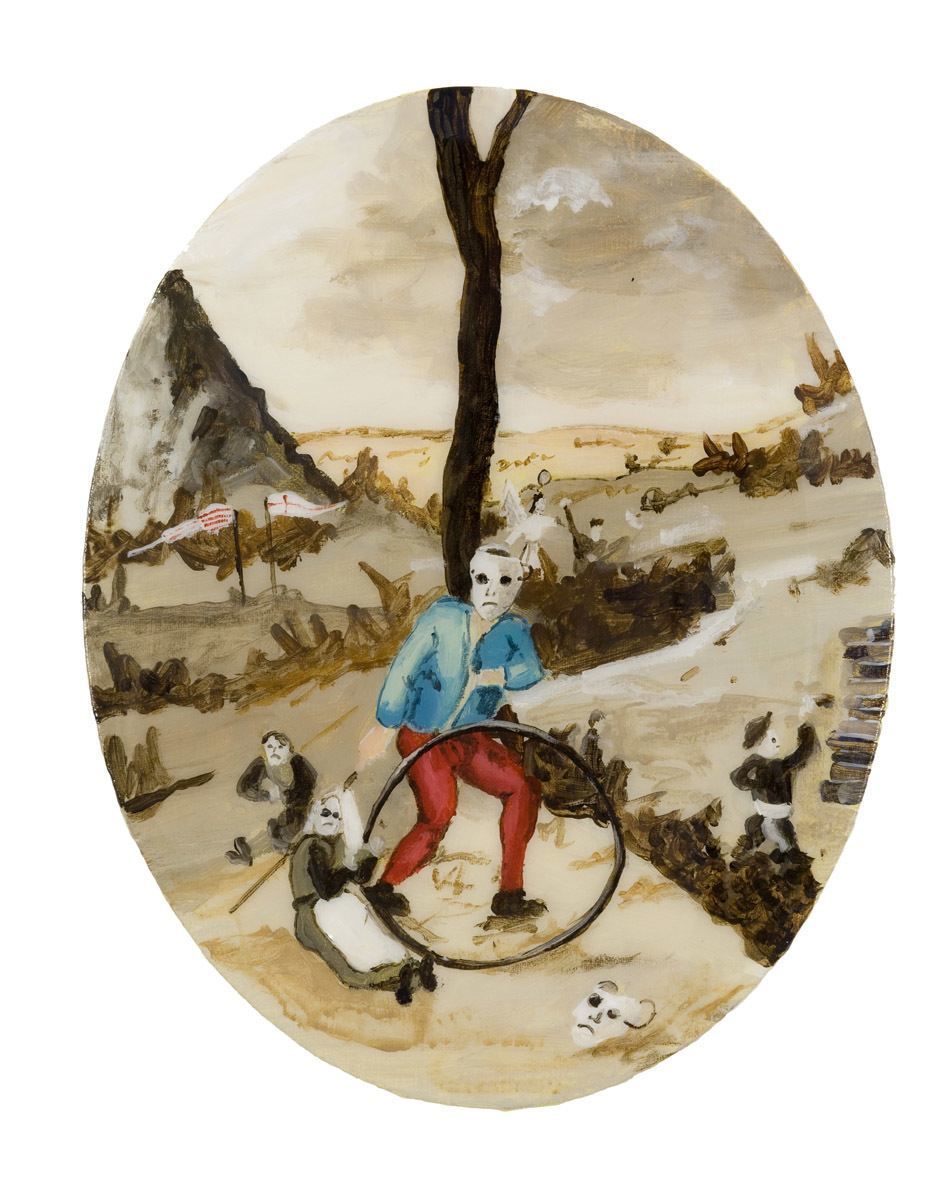
After Breugal, The Wheel, 2010, Acrylic and resin on canvas, 8 x 10 in. / 20.3 x 25.4 cm

I found several oval paintings on her website so she this is potentially more significant as it suggests she is making more than an occasional choice to use this shape.

However, an oval is fundamentally different from a circle (just as a square is very different from a rectangle)… an oval is not equal, like a circle, it’s like a rectangle with rounded corners. Geometrically it’s very different. It’s also the shape if you turn a circle away from you halfway before it becomes a vertical line.

I don’t know Breugal well enough to know the  particular painting that is being referenced, or even what part of his style or oeuvre.

Certainly in painterly terms this not even an oil sketch to his finished paintings, more a parody or cartoony sketch, though it is surreal in a similar way with a dove flying out of the protagonists head. But I can’t feel any of the religious meaning… it reminds me of an irreverent schoolboy sketch of the Mona Lisa… without any grace, beauty or power. It’s Breugal because of the surreal imagery and old fashioned clothes, but is not captured any of his soul.

Once again, I think you’d need to be rich and artistically educated to appreciate or pay money for this. So, even though her stated aim is to describe her own inner life and emotional responses, if these are opaque to the viewer then it’s private art.

In terms of the tondo I can see more of a point, like Mark Fairnington she features a circle which references the curved surface. And the vertical tree and red legs roughly split the canvas into three like a tryptich, which is interesting.

It would be very different if it had straight sides which were parallel to the central tree so I think there’s something here in the geometry of straight lines and curves, and using the tondo as part of your composition… but nothing fundamental in terms of enhancing meaning.

Mindy Lee:


Medusa’s Overfaced (Caravaggio) | Acrylic on paper plate | 24 cm diameter

medusa-carravagio.jpg

Fun, but fine art rather than painting… or maybe sculpture. And I don’t know how meaningful this would be if you didn’t know the original painting…. which although famous might still have limited recognition with the general public.

It reminds me of a lot of work I’ve seen in third year Graduation shows.

She chose to do a whole series of work on plates, which are round, but then she uses this roundness as a plinth rather than as a flat painting surface. And plenty of busts have a round plinth, so I’m not sure how relevant it is to painting.

Personally I like it in a fun sort of way but it doesn’t go very deep and I’m not sure it has any meaning. I think I’d soon get tired of it so would resent paying money… but it would be great in a museum and to stimulate debate.

She uses it for its sculptural framing (most busts are on a round plinth) and because of a plate’s association with food. But I don’t think it helps me find what it is about a tondo’s that would suggest themselves for a  painting… I may have to find out for myself.

Virginia Verran:

I can see the internal cohesion in Verran’s drawings (they are drawings rather than paintings both by medium and line). It feels like they are designed and constructed within the todo, rather than the tondo being an almost arbitrary canvas choice –  these are not rectangular drawings in a circular home… these are circular drawings.

Most of her work is fantasy scenes but her tondo’s are abstract, which is interesting.

‘Bioshereblues (2), pens and graphite ion mdf, 2013

(I’m assuming mdf as circular canvases are expensive? And drawings don’t sell for much?)

1302.jpg

Not fantasy (in the text book it says she uses delicate lines to depict fantasy scenes), but she’s got life and dynamism into her drawing, maybe even narrative, by likening it to a living cell.

What is it about this that makes it look like it was drawn for the tondo?

I think it’s the sense that the drawing evolved inside the tondo with the tondo an essential part of its evolution and meaning, whereas all the others look like they were ‘put’ inside a tondo.

Other contemporary tondo painters:

I did an experiment in my sketch book, as I suspected that tondo’s might work for an all over abstract painting. I used monochrome as I liked the monochrome paintings of Yan Pei-Ming and tried to make two all over paintings without reference to the shape, so I could see if the shape affected the outcome.

I don’t think the tondo was any better or worse than the rectangular painting, though it definitely gave the painting a different feel. I think the tondo adds a slight USP as it’s more unusual.

Next I Googled ‘modern tondo painting’ and the search page exploded with results. I wouldn’t classify any of these as art as there’s no meaning, but they would look nice in your living room. Generally they are big, and on my unrepresentative sample a surprising amount were by entertainers , self taught painters, or people with limited artistic training. The going price was about £800 upwards.

Of course the ultimate in decorative tondo paintings are Damien Hurts’s spin paintings, which with his brand stamp (even today when he’s fallen from grace) probably still cost considerably more than £800?!DHS4823_c_771_0.jpg

In conclusion:

I can’t find any modern commercially successful artists who use the tondo as part of their meaning system, though there are plenty of successful decorative artists who use tondos.

There are a range of critically acclaimed artists who’ve used tondo’s occasionally and won prestigious art prizes for their rectangular paintings, but I couldn’t find any major prize winners for tondo paintings.

Which leaves me with a problem… how do I best use the tondo for this exercise?

There’s obviously a link between shape (boundaries are important) and meaning but no serious critically acclaimed contemporary painter has had major success with tondos, or used the form regularly, so it suggests there is a problem. However, tondos are common in decorative paintings which suggests there’s a stronger link with pattern than meaning?

A circle is a different emotional space to a rectangle so I think I will try and compose my paintings ‘inside’ the tondo. Like the brushes, medium and surface I’ll try and think of the tondo as an artistic choice, though as it’s dictated it’s not a free choice.

Using a tondo will further distance me from the painting as a window, which is good, and force me to consider my flat space in a sculptural way, whereas before I’d just taken it as a given.

I may find new possibilities, but like travelling I will certainly come back to the rectangle with new eyes.

Another way of thinking of it is being on a round stage rather than a proscenium arch… I know all paintings are ‘theatre in the round’ in that the audience (viewer) can see the whole stage at once… but acting in a circle would affect your performance. Maybe that’s what I mean by being open to the space I’m working in?

Look at artists who have focused on aspects of the domestic interior.

Charlie Day:

On his Artist’s Facebook Page (he runs a gallery, Studio One Gallery, with his wife… isn’t that a bit like actor’s running a cooperative agency?)… anyway, at the moment the gallery doesn’t have a home so he must be selling his paintings elsewhere such a Saatchi Gallery Online. On his Saatchi online CV he includes a solo show at his own gallery (but doesn’t say it’s his gallery) which is a bit naughty.

He paints coastal semi-abstract landscapes culled from dog walking memories, but for my purposes I’m concentrating on his domestic interiors. Some are still lifes which remind me of my ‘Drawing 1’ and ‘Practice of Painting’ OCA courses. My memory is that though interiors can be still lifes, any arrangement items on a shelf could be said to be a still life, the artistic DNA is different. Still lifes are aesthetically based (so are nearer to abstracts) while interiors which are meaning based.

Charlie Day says his work includes, ‘… quick descriptions of representational objects in acrylic and charcoal, born of his experiments with the genre of ‘Bad painting.’

He currently works, ‘… mainly on what he calls ‘found cardboard’ culled from old ring binders which, because they are made of mixed materials, cannot be recycled. He takes these cast-off objects, which would otherwise be sent to landfill, and turns them into new artworks.’ It’s great to recycle but one can’t help being a little cynical and think that it’s more to do with it being a cheap material as I doubt you can make a living selling paintings on cardboard, and his painting on Saatchi are all on canvas.

So Lonely Here Without You Painting by Charlie Day

Sink.jpg

I like this, it looks like the taps are friends and one is turning into the other… it makes me smile. It’s an interior not a still life because it’s a ‘natural’ part of the room with ‘found’ objects in their natural state… in this case the sink. And tells us something about the owner, in this case we can make up myriad stories. The one Charlie gives is that this is the sink of a famous painter who bought one of his first paintings.

I also like the rough impasto as the sculpted paint that has a warmth and humanity to it. It feels almost alive and I feel like I know this sink.

It’s faux naive and does the job perfectly.

Not to copy this his style but I could definitely use the idea of quick bold descriptive, almost sculptural, painting with thick paint.  It comes from the heart… is not academic… and is almost like action painting where the energy and process of painting that is caught in the brushstrokes is almost as important as the finished piece.

Interesting to note his CV:
2016 MA Fine Art (Dist.), University of Brighton
2008 BA (Hons.) Fine Art (First Class), Central St Martins School of Art, London

Academically he was a high flyer as these are both top institutions, yet he paints in a loose, naive, almost expressionistic style

Jacquie Utley:

Here is her artists’s statement:

I work between the mediums of drawing and painting. I work in ongoing series often alongside each other, the still life paintings examine everyday objects and ornaments that sit side by side on shelves and ledges or in cabinets. The notes and drawings are the starting point for the paintings it then becomes the constant shifts that happen on the surface of the canvas between image and paint that becomes the area of investigation. A recent series of small scale paintings examine interior spaces and suggested narratives.

She calls them still lifes but because her subjects are ornaments sitting in their natural position, and she is wrapping narrative around them, I would say she is talking about interiors.

By allowing for the slippage between image and paint chance plays a big part in her painting, and in working in series she gets to know her subject very well. So, it’s almost like a series of dances ,or conversations, on the canvas. A structured improvisation where she leads the painting and then the painting leads her; like a visual meditation or of the objects and their possible meanings.

This is a very appealing way of working as I enjoyed working in series on my monotypes (maybe I could introduce an element of printing into my series?) and loved the way chance can make suggestions which push you further.

Jacqueline Utley, Flower Vase Sings, 2012, Oil on canvas, 12 x 18 cm (4.72 x 7.09 in)

Screenshot 2019-07-25 at 22.41.33.png

Very interesting, this is rough painted but in a very different way to Charlie Day. It’s not impassioned, and emotional… not homely… not accessible… the objects are barely readable… the physical record of the process doesn’t matter… the paint is placed on the canvas rather than sculpted… it’s much more high art. I don’t ‘get it’ but obviously people do and she sells for good prices at auction.

This would have to go in my elite box as I think you need a high level of artistic training to understand it. Unlike the Charlie Day’s painting whom anybody could read and appreciate. Yet in common with Charlie it has a faint whiff of naive painting, however in Jacquie’s case she shares something of a young child’s first attempts at figurative painting, rather than an untrained Saturday painter.

It’s reflective  and  looks and feels more like a still life than an interior, but as it’s in the OCA textbook they must classify it as an interior, so the classification is quite wide.

I like the way of working but don’t like the result as I can’t connect with it, but I’ll try working in series and not worry about ‘getting it right’. I also think I need to re-asses my criteria as to what makes a good painting, so I don’t limit myself, as some paintings I would dismiss as failures are critically acclaimed.

My main take is to be brave and work outside my comfort zone and produce images that I might not judge as successful. I could try ‘placing’ the impasto paint instead of moving it sensuously… and I might just capture something meaningful that I’d otherwise have missed.

Annabel Dover:

To read the runes of her practice she’s a storyteller, whether that’s painting objects (nick-nacks) around her house and grouping them together or canvases with subtle ‘story imprints’, like ghostly memories, in loose thin paint. It reminds me of those TV dramas (usually horror or detective) where somebody can hold an object and ‘see’ its memories.

Sometimes she writes down the stories and sometimes she leaves it to the viewers imagination.

It’s almost as if the objects are lightening rods for the world they were part of, or magic totemic objects carrying hidden stories of lost peoples.

She works in many mediums with much of her work being sculptural, and often groups her work, and creates meaning, by putting them together in collections. Sometimes her collections are exhibited in site specific settings (such as a wood rather than a gallery) where she makes the environment gift her art added meaning.

It’s difficult to find any ‘typical’ examples of her work or any paintings that feature a domestic interior.

head.jpg

I chose this because it is a domestic object and the thin tonality suggests a face and a story.

Annabel Dover, 2006, Bungalow One Tree, oil on board, 15x18cm.

Bungalow_one_tree.jpg

Again thin paint, but this time bold colours.

What I take from her work for my practice is the use of suggestivity for creating story, and how story can enchant the simplest of objects. So for my interiors I could try and make the real subject of my painting the imagined story of the objects rather than the object itself.


Assignment 3 feedback: Suggested viewing

Yan Pei-Ming – looking at monochrome and impasto technique.

Help…

YPM_1003__medium.jpg

The viewer reads in the context and is deeply moved to help… where… what… how… who… but also on the deeper ideas of charity, foreign aid… how we are numbed to TV appeals and conflict in distant countries.

Yan Pei-Ming: b. 1960 (Shanghai – Chinese)…

He was refused entry into Shanghai art college so enrolled in the École des Beaux-Arts in 1980, graduating in 1999. Therefore must have had money? Well off family? And took nearly 20 years to graduate so a part time degree while working?

From 1985, so before he graduated, he had several international group exhibitions, with his first solo exhibition in the United States  at David Zwirner in New York City, May 2007. Which I take as a stamp of international commercial success.

His trademark style is that he paints rapidly with big brushes on giant canvases in black and white or red and white – his most famous for paintings are of Chairman Mao.

Although he is best known for his is portraits of famous figures of the 20th century he spends a lot of thought on the emotional and psychological context of these paintings in his exhibitions and they take on a different meaning because of how they are displayed. He works hard on how these paintings relate to the modern world, to each other… and to the nature of power; though he says the ultimate power is in the paintings themselves.  So although his thick paint feels feral and his images visceral they are always framed by meaning as he refers back to famous paintings, relates them to other paintings in his exhibition, and to modern politics.

This is a video of his 2015 Salzburg exhibition: https://www.youtube.com/watch?v=synI5e1Y8II where he explains a little of his thinking.

And here he talks about his work in series… https://www.arte.tv/en/videos/050046-012-A/atelier-a-yan-pei-ming/

He says he is interested in ambiguities and emotion; wants the viewer to enter his paintings through imaginary (and slightly sinister) landscapes; and to feel the physicality of the paint. Which makes his work a really interesting mix between figurative, sculptural, emotional and ideas based painting.

His backgrounds are suggestive and intriguing – and while his figures are more real than real with personality popping out of their eyeballs, their features often emerge out of  a melange of intrigue.

He uses black and white because he finds colour interrupts the image, and makes the paintings more powerful. I agree and think his black and white paintings are nakedly honest and emotionally powerful.

Black Selfportrait
2007
Oil on canvas
Image Size: 137.8 x 137.8 inches 350 x 350 cm

0000015676.jpg

As a postscript he seems to use famous photographs and paintings as source images, which already bring heaps of meaning and status to his paintings. Today a lot of marketing is about visibility and these paintings do half his job for him as they are instantly recognisable. Even an unknown artist painting a famous person will get more interest than if they were painting somebody unknown. His ‘famous people’ paintings are by no means fan art and he does repaint rather than copy, but I think they are much weaker than his self portraits and verge on the cynical.

And in some paintings he lets his paint run which makes you aware of the painter and the vertical flat surface… for some painters I think this works really well but I think he’s much stronger in his sculptural work where the 3D paint catches the light and transforms flat images into living worlds.

What I think works really well and I can use in my practice is the indistinct and suggestive mark making which works so much better than spelling it out. And the power of monochrome.

Here’s a visual response in my sketchbook.

Final Assembly, ink on A3 drawing paper

IMG_20190718_212329.jpg

It may be simplistic and was better when it was subtler but it captures something of the moment where a mum was looking at her child from the kitchen window before she had to turn away and get back to work.

This is a new way forward for me, painting from memory in a fluid way while trying to capture a significant emotional moment, and feels good.

I like his impasto work but am not working in impasto yet… it’s something I can store away and try out later. As is two colour painting – black and white, where unlike ink you can correct mistakes (once you’ve covered up the white paper you can’t turn it back into a highlight) but you can paint on highlights with your white paint.

Glenn Brown – for distortion and a play with media.

b. 1966 – British

The Hinterland, 2006, Oil on panel, 148 x 122.5cm

3de57799766ee5fb1c83bfd0a9d228692c8f50f0.jpg

This is useful because I very quickly found his work derivative, boring and utterly pointless…. decoration passed passing itself off as art.

But, jaw droppingly skilful.

As I was walking the other day I saw a home decorator and this got me musing about the skill of traditional plasterers. Plastering is not a DIY job. I had an artist friend who supported his early career by working as an occasional plasterer (he ended up as the youngest ever head of Dublin art school) and another who had a five year apprenticeship as a carpenter, who could do anything with wood.

Painting as trompe l’oeil, it struck me, is a craft skill, which is why many classical painters started as apprentices. Making a flat surface look like a window is nio different in essence than a master craftsman making a chair. But neither, I would argue, are art: at least in the sense that they don’t deal in the world of ideas, emotions or concepts. One is functional in that it captures a likeness and the other provides you with somewhere to sit.

So painting, per sé, is not art. But painting can be art… it’s the added value, where the subject is the vehicle for something else that makes a painting into art rather than a window or human camera.

Coincidentally, the real economic value and status has always been in art rather than painting… the great masters were so much more than masters of ‘window’ painting, they used their skill and subject matter as a vehicle to examine the world.

So I learned something very important… that I don’t want to be a painter as window, or a painter as thief using other people’s work. And although skill is very important, of itself it’s not the end point because here is somebody who is blissfully skilful (and no doubt commercially very successful) but who’s work has no passion, no connection and no ideas… it’s pure cleverness.

Interestingly, having had a strong gut reaction to his work I then researched him and found he is known for the use of other people’s work, and has been accused of plagiarism.  He takes famous paintings or photographs and digitally manipulates them before meticulously painting the results to create a flat, almost digital ,surface.

I’ve also learned I like movement and texture in my work.

The Day The World Turned Auerbach 1991, Oil on canvas, 56 x 50 cmglenn brown the day the world turned auerbach.jpg

This looks more like a forgery more than an appropriation.

Daydream Nation (2017)

BROWN-2017-Daydream-Nation_Gagosian-742x1024.jpg

This looks as though a painting has been put through a computer programme to change the skin to wallpaper. For me it has no soul, even with added cloudy eyes.

Edvard Munch – related to German expressionism.

b. 1863 – d. 1944, Norweigan

As I know a little of Munch I didn’t want to be biased so decided to research him first before looking at his paintings.

My research gave me a tingle as I could see so much of me in him, though I never had his bohemian lifestyle, heavy drinking, mental instability or fear of insanity.

Melancholy 1891

Edvard_Munch_-_Melancholy_(1894).jpg

I get this, it’s meaningful to me, without words.

Munch spent a lot of time on the edge of penury and was supported by his dad. As an actor only ever having signed one non acting contract (for three months) in over 40 years I know what not having a good stable income feels like. He also came from a religious household… and my dad was a vicar, who died when I was 13, but my mum was very religious and my brothers both became religious leaders.

When he went off to art school Munch was influenced by Hans Jæger, a leading bohemian, who pushed him to paint his own emotional and psychological state. I missed the bohemian bit but am very interested in capturing emotions.

Paul Gauguin, Vincent van Gogh and Henri de Toulouse-Lautrec were big influences in Paris and they are all artists I love, and who’s colour work I find moving.

Wikipedia says… He wrote his goal in his diary: “in my art I attempt to explain life and its meaning to myself.” This is at least part of the reason why I paint, to capture meaning (cage it) on canvas so I can examine it.

His friend Christian Krohg said:

He paints, or rather regards, things in a way that is different from that of other artists. He sees only the essential, and that, naturally, is all he paints. For this reason Munch’s pictures are as a rule “not complete”, as people are so delighted to discover for themselves. Oh, yes, they are complete. His complete handiwork. Art is complete once the artist has really said everything that was on his mind, and this is precisely the advantage Munch has over painters of the other generation, that he really knows how to show us what he has felt, and what has gripped him, and to this he subordinates everything else.

Beautifully put.

Munch was inspired by Gauguin’s work and philosophy, and I love Gaugin’s work too;  his colours, his print like quality and blocky composition. And Gaugin reacted against realism, which I do, and said that “art was human work and not an imitation of Nature”.

I’ve just experimented with prints and found them captivating and Munch really liked printmaking and woodcuts too.

He formulated the Synthetist aesthetic, and The Talisman, by Paul Sérusier, a principal works of the Synthetist school (below) was my favourite painting for many years.

1200px-Serusier_-_the_talisman.JPG

Munch’s mature style includes a simplification of detail, shallow pictorial space, minimal background to his up front figures, and an almost static theatrical pose that signified emotional states which are all elements I connect with. He wanted his people living and on fire, but they were symbolic rather than real people.

Ashes, 1894

NG.M.00809_2_pressebilde.jpg

For some reason this has the same feel as Peter Doig’s work which I also love… magical realism?

20091127030335_peterdoigwhitecanoe.jpg

My take for my practice is that I (when I get the technical skill) I can make stuff up and paint imaginary people and landscapes filled with my imagination. There are other things I want to do, but that’s definitely one of them.

I’d like to create worlds that I and my viewer can get lost in and where I can (metaphorically) dance on the canvas… in the moment and fully connected. Like when a director says action, if it’s really working, I don’t know what’s happened till he says cut… I’ve been in a different reality.

Leon Kossoff – use of impasto.

b. 1926 – d. 1919, UK, London

I’m starting with a blank canvas as I only vaguely know Kossoff’s work. A quick search threw up that he was mates with Frank Auerbach (who had a similar impasto technique and local London subject matter). And they both studied under David Bomberg who birthed a lot of similar artists, so was obviously a very influential teacher.

His other artist friends included Francis Bacon, Lucian Freud and Keith Critchlow; so he was a child of his time and I might expect similar concerns.

Children’s Swimming Pool, Autumn Afternoon, 1971

T03246_10.jpg

This is very different from Frank Auerbach, as though the paint is impasto it is brushed much less fractured and figurative.

I have seen this in the flesh and it’s much darker, so I don’t know if this has been photoshopped or he did several versions.

Reading on the Tate website about his working methods is revelatory. He scraped off the paint and repainted continually over several weeks. This feels like the equivalent of correcting my lines in life drawing… or making multiple oil sketches for a finished piece. In effect he is working in series like I did for my last assignment, being open to chance (seeing what works and doesn’t work) and really understanding his space – the canvas – and how his painting works inside it.

After this process, when he was ready, he painted the final image in a few hours.

What this meant was that he combined process with freshness, looseness and spontaneity to produce seemingly effortless and stunning paintings.

This is a good pointer for me and reinforces what I learned with my last assignment, the value of working in series and evolving a painting over time till you really understand it. Then being able to spontaneously capture it in one creative splurge.

I think this is a working method that would really suit me.

At t he moment, to work on scale, and sacrifice so much oil paint at £5 a tiny tube, is too expensive… but there will be ways I can come close. Maybe work small… do one big mock up… then paint the final canvas?

Booking Hall, Kilburn Underground,1987

T05531_10.jpg

The Tate goes further into his working methods and explains how he took direct sketches from site (charcoal) and pinned these round his studio. I painted my Mother-in-Law’s Tongue solely from sketches – no photographs and no access to the real plant while painting.

Mother in Law tongue.jpgThough I launched straight into the final piece and it’s tight it still has a quality missing (as my relationship was with creating an image from inside me not copying a photograph from outside me) from all my other work from Practice of Painting. It’s like the plant has a soul, and I really like it.

So, working from on site sketches is definitely something I would like to do. My life drawing is helping me with figures… I just need to get a bit braver in public spaces.

With Kossoff the physical and visual sensation is more important than representational accuracy, and that’s how I want to paint too.

Self-Portrait, c.1952

T07198_10.jpg

This is particularly interesting as he painted this while a student and was first being influenced by David Bomberg’s (he took extra classes) loose style, as different to the tight academic brushwork he was learning at Sty Martin’s Art School. And I’m a student too… so it gives me hope.

He painted wet on wet which is something I’ve tried and like, but was worried about the blurring of pictoral forms with my remnants of ‘this has got to look like what it is’. Here I can see how it works and that, though I can’t do it yet, it’s not something to be scared of. So, is another technique I can use in my practice.

Another technique which would be great to play with is that he painted straight from the tube and mixed on the canvas… I’d love to do that.

This unit has set me thinking about the tools (both surface and mark making) that I use to make a painting and it’s interesting how Kossoff used the brush handle to scrape the paint away on his neck, and use line on an expressionistic tonal painting. Something else for my toolbox.

The Tate comment on this painting is particularly useful. It says that this is not a likeness based painting, but an ‘intense evocation of a young man’s expression and emotion, devoid of any social contact or context.’ Which is what I was I did when I was painting back in to my prints, or at least that’s what I ended up with. Not me per sé (though if you know me you can see me in here) but a universal yet specific man.

At least, that’s what I liked about my final image.

IMG_2031

Finally, there’s a quote from Leon Kossoff that is very resonate for me now on this course as it echoes how I am feeling… just substitute Understanding painting Media for Bomberg.

In 1995 Kossoff said that ‘Although I had painted most of my life, it was through my contact with Bomberg that I felt I might actually function as a painter. Coming to Bomberg’s class was like coming home’ (quoted in Paul Moorhouse, Leon Kossoff, exhibition catalogue, Tate Gallery, London 1996, p.12).